
Latest Products


Contact Us
- No.97, 4th Avenue, Binhai Economic and Technology Development Zone, Wenzhou, China
- sales@gzp-valve.com
- +86-577-85859689
Why choose us
Our Service
We guarantee to reply clients within 24 hours and solve your problems in the first time with phone call.And our sales team will always be online for 7 days every week.
Product Application
Our products are designed for use in a variety of applications, including water, oil, gas, steam, and severe service environments with high pressure and high temperature conditions.
Our Certificate
We hold several certifications, including CE, ISO 9001, API 6D, ISO 14000, and ISO 18000.
Production Market
Our products are sold in markets across Asia, Europe, and South America.
What Is V Type Ball Valve
A V-Port Ball Valve has either a 'v' shaped seat or a 'v' shaped ball. This allows the orifice to be opened and closed in a more controlled manner, with a closer to linear flow characteristic. This type of valve is also known as a control valve because the flow velocities need to be controlled depending on the application.
 V Port Ball Valve
Ball valves are designed to be used in a variety of applications and markets, but a V-port ball valve offers the added ability to be used as a control valve where necessary.
Add to Inquiry
Advantages of v-port ball valves
Precise flow control
The openings of v-ball control valves are available at different angles (15⁰, 30⁰, 60⁰, and 90⁰), which offer equal percentage flow characteristics. Rotating the ball anywhere between 0⁰ and 90⁰ helps achieve the desired flow rate. Precise flow control allows for better accuracy of fluid flow in piping systems.
Low pressure drop
The flow path of fluids through the V-port ball valves is usually straight. The straight flow minimizes pressure drop across the valve. Compared to other control valves, v-port ball valves have a relatively high flow coefficient (Cv or Kv). The high Cv (or Kv) value makes it possible to use smaller V-ball control valves to achieve the same flow rate as other larger control valves.
High shut-off pressure
A quarter turn on the ball is sufficient to open or close a v-port ball valve. The ease in operation makes it possible to open or close the valve at higher working pressure. Hence, lower torque actuators are ideal for its operation.
Bubble tight shut-off
The principle of floating ball used in V-ball valves helps in providing a bubble-tight shut-off and aids in flow regulation. When it closes, the ball presses against the seat by the upstream pressure. This provides an air-tight seal. The bubble-tight seal makes V-port ball valves suitable for gas applications.
Difference Between V-Type Ball Valve and O-Type Ball Valve
Difference in Spool Structure
The primary difference between the two types lies in the spool structure. The flow path of the O-type ball valve is a complete circle with a double-seat seal. In contrast, the V-type ball valve has a 1/4 ball core with a V-shaped opening on one side and is sealed with a single seat. There are also global spools with a V-shaped runner opening at one end, and these valves may use either a single-seat seal or a double-seat seal.
Suitability for Different Media
The O-type ball valve is typically used for clean media or media with only a small amount of suspended particles. It can achieve zero leakage when the PTFE (tetrafluoroethylene) seat is sealed. However, when the medium contains more impurities or granular materials, it is prone to clogging, which may cause the valve to lock and prevent proper switching.
V-type ball valves, on the other hand, usually feature hard metal seals and are used for media containing fibers, fine particles, and slurry. The V-shaped port and the seat help to cut through fiber media, making the V-type ball valve ideal for applications in the paper industry. Additionally, the partially spherical spool and single-seat seal prevent blockages in the valve.
Differences in Process Control Requirements
The O-type ball valve is mainly used for switch control and has poor performance in flow regulation. When equipped with an AT pneumatic piston actuator, it can provide fast on/off operation.
In contrast, the V-type ball valve is designed with a V-shaped port, offering better adjustability and a high adjustable ratio (up to 100:1 or higher). With the use of pneumatic or electric actuators, the V-type ball valve is primarily used for regulating control, although it can also be used for switch control.
Different Flow Characteristics
The flow characteristic of the O-type ball valve is "quick opening," making it suitable for on/off control. The flow characteristic of the V-type ball valve is approximately "equal percentage," which makes it ideal for regulating control applications.
Difference in Flow Channel Size
The flow path size of the O-type ball valve typically comes in two options: full diameter and reduced diameter. The flow path size of the V-type ball valve varies according to the process and design requirements and is generally reduced. Different ball cores can be used to meet specific flow requirements.
V-Type Ball Valve Structure
The ball core of the V-type ball valve features a V-shaped structure, and the valve core itself is a 1/4 spherical shell with a V-shaped notch. This design offers several advantages, such as large flow capacity, a wide adjustable range, shear force, and tight closure. It is especially suitable for applications involving fluid substances with fibrous characteristics. Typically, the V-type ball valve is a single-seal valve and is not designed for bidirectional flow.
The V-shaped edge of the ball valve helps to cut off impurities. As the ball rotates, the V-shaped blade of the ball comes into contact with the valve seat, cutting fibers and solid particles in the fluid. Ordinary ball valves lack this feature, which can result in fiber impurities becoming lodged during closure, causing difficulties in maintenance and repair. The valve core of the V-type ball valve, however, will not become stuck by fibers. Additionally, thanks to its flange connection design, disassembly and reassembly are straightforward, requiring no special tools, which simplifies maintenance.
When the valve closes, the V-shaped notch and the valve seat produce a wedge-shaped, scissor-like action. This not only provides a self-cleaning function but also prevents the ball core from becoming stuck. The valve body, valve cover, and valve seat all use a metal-to-metal point-contact structure. The valve stem is equipped with a spring that has a low friction coefficient, resulting in a small and stable operating torque.
The V-type ball valve operates with a direct 90-degree rotary movement, enabling precise flow adjustment. Depending on the angle of the V-shaped ball, different levels of proportional control can be achieved. The V-type ball valve is commonly used with valve actuators and positioners to allow for proportional adjustment. The V-type valve core is ideal for various control applications, offering a high rated flow coefficient, a large adjustable range, excellent sealing performance, and highly sensitive adjustment capabilities. It is compact in size and can be installed either vertically or horizontally. The valve is suitable for controlling gases, steam, liquids, and other media.
The V-type ball valve’s 90-degree rotary structure consists of the V-type valve body, pneumatic actuator, positioner, and other components. It has an inherent flow coefficient that approximates a specific percentage, adopts a double bearing structure, offers low starting torque, and provides excellent sensitivity, response speed, and exceptional shear strength.
Some of the main components include:
Ball
The ball is a sphere with a hole in the center, known as the bore.
Typically, the bore serves as the flow path for the fluid when the cross-section of the fluid flow path aligns with the bore. If the cross-section does not align, the flow is throttled or constricted. In a V-port ball valve, the ball features a V-shaped bore, which helps control the flow rate.
Stem
The stem connects the ball to the control mechanism that rotates the ball. It is equipped with packings, such as O-rings, to seal the stem and bonnet, preventing fluid leakage.
The stem can be manually operated using a lever or handwheel, or it can be actuated by electric, pneumatic, or hydraulic actuators.
Bonnet
The bonnet is an extension of the valve body that contains and protects the stem and its packing. It is typically welded or bolted to the valve body.
Made of hard metal, the bonnet covers the opening through which the stem connects to the external control mechanism.
Seat
The valve seats provide a sealing surface between the ball and the valve body.
The upstream seat is located on the inlet side of the V-port ball valve, while the downstream seat is found on the opposite side, adjacent to the discharge side of the valve.
Valve Housing
The valve housing, or body, contains all the internal components of the ball valve.
It is typically made of durable, rigid metal that protects the internal components. Additionally, the valve housing provides access to the external control mechanism that rotates the ball.
Common Applications of V Port Ball Valves
V-Port Ball Valves are becoming an increasingly popular choice for a variety of industries and applications. In the oil and gas industry. They are commonly use to control flow rate in production pipelines. As well as in subsea installations. Where their ability to maintain high pressure allows them to operate safely even at great depths.

Oil and Gas Industry
V-Port Ball Valves are widely use in the oil and gas industry due to their superior performance and durability. By providing precise control of both pressure and flow, these valves can help drill and production sites safely meet their goals for optimal extraction. Additionally, these valves are design to withstand high-pressure requirements common in this field. Furthermore, with automated actuators, they can provide a continuous stream of data relevant to operations ensuring that even the most remote sites have accurate information regarding pressure levels and other parameters. Ultimately, V Ball Valve are an ideal solution for any oil and gas application.
Chemical Processing Industry
V-Port Ball Valves are a great option for chemical processing applications due to their superior performance and reliability. They offer responsive control of flow, pressure, and temperature which is critical in these types of processes. Additionally, the valves can automate with external systems for greater precision, particularly helpful when ingredient ratios need to be exact. Furthermore, because of their durable construction and materials used. These valves are design to handle aggressive chemicals often found in this industry without breakdowns or leakage. Finally, by utilizing sensors in the actuators, users can receive detailed data regarding valve performance.
Water Treatment Industry
V-Port Ball Valves are an ideal solution for water treatment applications. They provide high-precision flow control which is essential when regulating water pressure and preventing backflow. Their aluminum construction and durable materials are design to resist corrosion. Making them well suited for the wet environments found in this industry. Additionally, automated actuators can use to increase precision and accuracy when controlling the valves. Finally, with a wide range of available sizes, they can handle large volumes of water with ease.
Power Generation Industry
V-Port Ball Valves provide excellent performance and accuracy in power generation applications. They offer precision control of flow, pressure, and temperature which is absolutely critical when running a power plant. Additionally, their heavy duty construction and durable materials are designed to stand up. To the high temperatures and pressures associated with this industry. Furthermore, they can automated with external systems to ensure. That the valves are always opened or closed as needed. Finally, these valves are able to work with a range of sizes. Making them well suited for large scale power production.
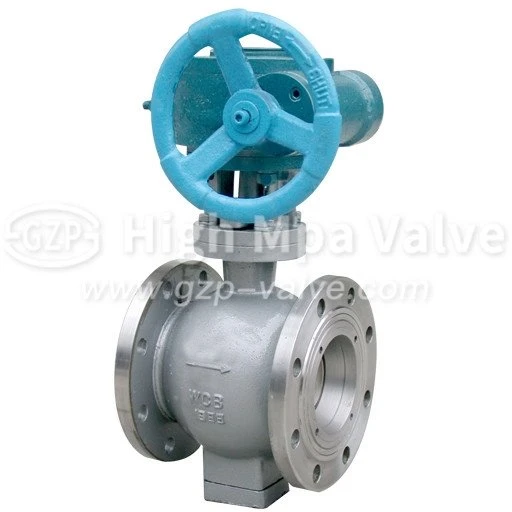
Are V-Ball Valves Directional?
A V-port ball valve is a directional valve with two openings at either end. Flow through the valve increases as the ‘V’ turns to its fully open state. It is designed to increase the flow rate over a wider range of openings than a standard port ball valve.
A ball valve is an essentially directional valve. It uses a pivoting ball with a hole in the center to control flow. If the handle is parallel to the pipe, then the valve is open, while if it’s perpendicular, the flow will stop.
Generally speaking, a ball valve can be bidirectional as well as unidirectional. While most the ball valves are bidirectional, a V-ball valve is unidirectional. It means this type of valve can only be used to control the flow in one direction.
When fully closed, the ball sits centered on the valve seat. When fully open, it is 90 degrees counterclockwise of the closed position. This is determined by an actuator. The ball can be adjusted between open and closed positions, and the actuator adjusts the open and closed stops to prevent it from moving out of the valve.
And although V-ball valves are directional, they have some common features. They are often the most economical full-port valves available. The outside of the valve is marked with an arrow which shows the direction of the flow. There is only one seat in the valve, so it flows only in one direction.
Material: Ensure the valve material is compatible with the fluid or gas it will control. Stainless steel is a popular choice for its durability and resistance to corrosion.
Size and Pressure Rating: Match the valve size and pressure rating to your system requirements to ensure optimal performance.
Flow Characteristics
Consider the flow coefficient (Cv) and whether a full port or reduced port valve is needed for your application.
End Connections
Choose the appropriate end connections (threaded, flanged, or welded) that fit your piping system.
Temperature Range
Verify that the valve can operate within the required temperature range for your application.
Our Factory
Our company owns a full set of equipment,complete processing and testing methods.The establishing of CAD valve design center and three-dimensional simulated manufacturing experimental design system ensures that new products with high quality can be developed promptly.Implementing perfect quality assurance system,our company is making unremitting endeavor for obtaining API certification on the passing ISO 9001, CE, API 6D International Quality Certification.


FAQ
We're well-known as one of the leading v type ball valve manufacturers and suppliers in China. If you're going to buy high quality v type ball valve at competitive price, welcome to get more information from our factory.
cpvc brass ball valve, 3 Way Ball Valve, dn25 ball valve